For many years, software teams organised their work around two clear responsibilities.
Frontend developers handled everything users interacted with. They focused on layout, browser behaviour, and user interactions. Backend developers worked on server logic, APIs, and database operations.
The structure was simple and easy to manage.
A user action triggered a request. The server processed it, stored the data, and returned the response. Many early web products ran comfortably within this model.
As products evolved, however, the surrounding technology began to expand.
Applications started connecting with analytics platforms, authentication systems, external services, and background processing tools. A single action inside the interface could now trigger several processes running behind the scenes.
At that stage, dividing work strictly between frontend and backend developers began leaving certain areas of the application without clear ownership.
How Product Architecture Changed
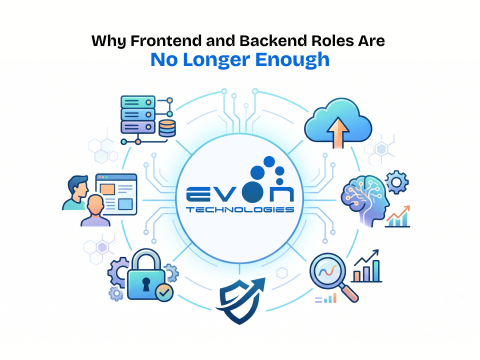
Most modern applications now operate with several supporting components working in the background.
These elements are rarely visible to users, yet they play an important role in keeping software stable and reliable.
A typical production environment may include:
-
Container platforms
-
Background job queues
-
Monitoring and alerting tools
-
Logging services
-
Third party integrations
-
Automated build and deployment pipelines
Each of these layers supports a different part of the application’s operation. Together they allow systems to run continuously, handle large volumes of activity, and recover when problems occur.
Under normal conditions users rarely notice these components. When one fails, however, the disruption can spread quickly across the application.
Where Frontend and Backend Roles Fall Short
The pressure created by these additional layers usually builds slowly.
Initially, developers handle issues as they appear. Someone updates a deployment configuration. Another engineer investigates an API error affecting the interface.
Over time these interruptions become more frequent.
Monitoring alerts require investigation. Integrations occasionally fail. Deployment pipelines require adjustments.
Developers who were hired to build product features begin spending more time maintaining these supporting layers. Gradually, less time remains for building new functionality.
Specialised Roles in Modern Systems
To handle these responsibilities, many organisations introduce engineers who focus on particular areas of the technology stack.
Typical roles include:
- DevOps engineers responsible for infrastructure and deployment pipelines
- Integration specialists maintaining connections between external services
- Data engineers supporting analytics pipelines and reporting systems
- Security engineers monitoring authentication and access control
These specialists maintain the technical foundation surrounding the application. Their presence allows frontend and backend developers to focus primarily on building and improving product features.
Why Companies Use Staff Augmentation
Not every organisation needs these specialised roles permanently.
Some requirements appear only during certain stages of growth. A company expanding integrations may require integration specialists for a limited period. A platform migration may require experienced infrastructure engineers.
Many organisations address this need through the staff augmentation model.
With staff augmentation services, additional engineers join an existing team for a defined duration. They participate in the same sprint cycles, use the same development tools, and collaborate directly with internal developers.
In some cases, companies also use staff augmentation consulting to identify areas where additional expertise can strengthen the technical structure.
Choosing the Right Staff Augmentation Agency
Introducing external engineers into an active development project requires careful coordination.
Technical ability is important, but the ability to work within an established team structure matters just as much. Most organisations already follow defined practices around version control, sprint planning, and deployment.
For this reason, companies often evaluate a staff augmentation agency using factors such as:
- Experience working with complex product environments
- Availability of engineers with specialised frontend and backend expertise
- Structured onboarding processes
- Consistent communication during development cycles
When these aspects are managed well, external engineers become productive quickly and integrate smoothly with the existing team.
When Dedicated Teams Make Sense
Some organisations eventually move beyond individual augmentation and introduce dedicated development teams.
Instead of adding engineers one by one, they bring in a group that includes multiple technical roles working together.
Over time this team becomes familiar with the product architecture and can contribute more effectively to long-term improvements.
For products that continue evolving over several years, having engineers who understand the system history often makes development more efficient.
How Evon Technologies Supports Product Teams
Evon Technologies has worked with product companies facing these challenges for many years - with an expert team of custom web developers, app developers, and developers for solutions like Odoo, Salesforce, Mulesoft, and NetSuite.
Many clients approach us when their applications expand beyond the original frontend and backend structure. Integrations increase, infrastructure grows, and internal teams require additional technical support.
Through structured staff augmentation solutions, Evon provides engineers experienced in areas such as:
-
Frontend and Backend development
-
API integrations
-
Distributed system performance optimisation
Our delivery centre operates from a Tier-2 city in India. This allows us to maintain stable engineering teams with relatively low attrition, helping clients retain continuity across long running product environments.
Write to us at This email address is being protected from spambots. You need JavaScript enabled to view it. or get in touch here.