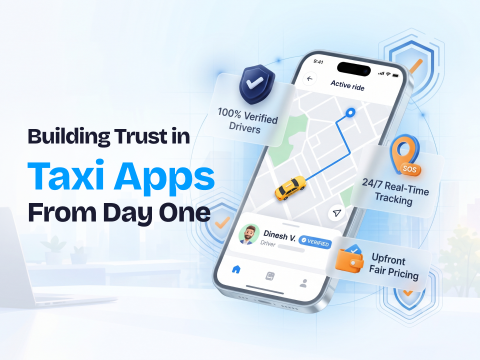
Ask any rider why they stick with one taxi app over another and the answer rarely starts with pricing. It starts with whether they feel safe getting into a stranger's car late at night, or whether their family can see where they are if something goes wrong. Taxi app safety features like SOS buttons and real-time tracking sound like small technical checkboxes on a spec sheet, but for the person booking the ride, they're often the whole reason to trust the app in the first place. Taxi-booking app development companies that treat safety as a launch-day priority, not a patch they'll get to later, tend to earn loyalty that pricing wars can't buy.
Trust > Features in a Taxi App?
A clean interface and fast checkout get someone to download your app. Safety is what gets them to open it again, and again, until it becomes the default. Ride-hailing runs on repeat behavior, and that only forms once a rider stops thinking twice about whether the ride is safe. That shift, from hesitation to habit, separates apps people try once from apps people actually rely on.
Safety cannot be an afterthought. Plenty of ride-hailing startups have learned this the hard way. One bad incident that makes local news can undo months of marketing spend overnight, especially where riders already have Uber or an established local player as a fallback. Retrofitting safety features after a scare looks reactive and rarely rebuilds confidence at the pace it was lost. Building these protections in from day one is what actually protects the brand you're trying to grow.
How Does an SOS Button Actually Work in a Taxi App?
The idea is simple on the surface. A visible, always-accessible button sits inside the active ride screen, and a single tap alerts emergency contacts, local authorities, or the platform's own safety team, often sharing live location data automatically.
The details matter more than the concept though. The button needs to work with one thumb, without hunting through menus, because in a genuine emergency nobody has patience for a slow interface. Evon's taxi app builds this SOS functionality directly into the user app as a standard feature, not a premium add-on. Safety shouldn't be something a rider pays extra to access.
Real-Time Tracking; More Than Just Maps
Real-time GPS tracking gets pitched as a convenience feature, letting riders watch their driver approach on a map instead of guessing when the car will show up. That's true, but it undersells what the feature does for trust. When a rider shares their live trip status with a friend or family member, the ride stops being a black box. Someone outside the car knows the route and the arrival time in real time. On the operator's side, the same data lets the admin panel monitor every driver on the road through live map views, so a company can spot a car going off-route and act before it becomes a bigger problem.
Other Safety Features That Riders Expect
SOS buttons and live tracking get the most attention, but they work best as part of a wider net. In-app chat and calling let riders reach their driver without exchanging personal phone numbers. Secure, verified payment gateways cut down on disputes that erode trust just as fast as a safety incident does. AI-powered support agents that resolve a booking issue at 2 a.m., without waiting for a human agent to log on, close a gap traditional support hours leave wide open. This isn't one-sided either. Trip logging and the ability to rate riders after a trip give drivers their own layer of protection, and a driver who trusts the platform to have their back tends to stay on it longer.
Affordability of Safety Tech
This is usually where founders assume they'll need to compromise, and it's the biggest myth around building a taxi app on a startup budget. SOS buttons, live tracking, and AI-driven support used to require serious in-house engineering. Ready-made, white-label taxi platforms now ship with these features built in, which means a small operator can launch with the same safety standard as a much larger competitor, without spending months building it from scratch. The gap between a bare-bones app and a genuinely safe one is far smaller than most founders expect.
Launch, With The Safety In Place
Every argument for shipping safety features later, to save time or cut initial costs, assumes riders will give a new app the benefit of the doubt while it plays catch-up. Most won't, especially where an established competitor already has these protections in place. Trust is far easier to build into a product from day one than to bolt on after a bad experience makes headlines. For a taxi startup, safety isn't the feature you add once you've grown. It's the feature that lets you grow at all.
Ready to Launch a Safer Taxi App with Evon Technologies?
Evon Technologies builds real-time GPS tracking, in-app chat, and AI-powered support agents directly into its taxi booking app solutions, so safety is part of the platform from day one rather than an upgrade you plan for later. Backed by CMMI Level 3 and ISO 27001 certifications, a 600-plus person team, and nearly two decades of building software since 2006, Evon's taxi booking app development services help startups launch a fully-featured, secure app in about two weeks.
Write to us at This email address is being protected from spambots. You need JavaScript enabled to view it. to see the full safety feature list, request a free demo, and get a cost estimate for building a taxi app riders can actually trust.