AI Didn't Kill Art. It Opened the Box.
For most of business history, creative work came with a shrug. You wrote a brief, handed it to a designer or an illustrator or a studio, and waited. What happened next was a mystery. Days later something came back. Sometimes it was perfect. Sometimes it missed completely, and you couldn't say why — because the process that produced it was invisible to you.
We accepted this. Art was supposed to be mysterious. Talent was a black box, and you paid for whatever came out of it without ever seeing inside.
AI is quietly ending that arrangement. And the interesting part isn't that machines can now make images. It's that the mystery is gone.
Style used to be a gift. Now it's a setting.
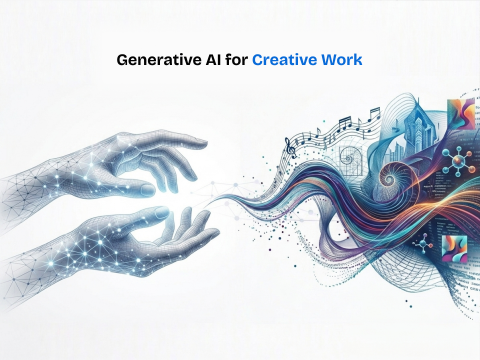
When a generative model turns a sentence into an image, it drags the hidden machinery of creative work into the open. Style becomes a setting you can dial. Composition, lighting, mood - the things that used to live only in a specialist's instinct - become explicit choices you can adjust and repeat.
You can generate ten directions in a minute, compare them, and steer. You can lock a look and reproduce it a thousand times without drift. You can take your own brand's visual language and train a model to speak it fluently.
That's what demystifying really means. Not that art becomes trivial - good taste still matters, and a human still makes the calls - but that creative output stops being an opaque, one-shot gamble. It becomes a process you can see, control, and scale.
You've been asking the wrong question about design.
For a business, that shift changes the question entirely.
The old question was "who do we hire to make this?" The new one is "what creative capability do we want to build into our product?"
Those are very different questions. The first treats art as a service you rent when you need it. The second treats it as something your software does on its own, continuously, at scale:
- A product that generates on-brand visuals for every user, instead of a stock library everyone else also uses.
- A game or 3D experience that produces assets and environments faster than any manual pipeline could.
- A chatbot that doesn't just answer - it illustrates, mocks up, and shows.
- Marketing systems that spin up campaign variations in minutes instead of weeks.
None of this removes human creative judgment. It removes the wait, the bottleneck, and the mystery between idea and output.
Everyone can make the image. Almost nobody ships it.
Here's where most "AI changes everything" articles stop - right before the hard part.
A generative tool in a browser tab is not a capability. It's a toy until it's wired into something real. The distance between "I made a cool image on my laptop" and "our product reliably generates on-brand, safe, high-quality visuals for ten thousand users a day" is enormous -and almost none of it is about the model.
It's about engineering. Training or fine-tuning a model on your own assets so the output actually looks like you. Building the pipeline that feeds it, the guardrails that keep it safe and on-brand, the integration that puts it inside your app instead of beside it. Managing cost, speed, moderation, and the thousand edge cases a demo never shows.
This is the same gap that swallows every AI project. The tools are democratized. Turning them into a dependable business capability still takes people who have done it before.
Your competitors already made this call.
The mystery around creative work is gone. What's left is a straightforward build decision - and, like any build decision, it comes down to whether you have the right hands.
Some of it you'll do in-house. Some you won't, because the specific skills - generative model integration, RAG on your creative assets, 3D and gaming pipelines, the safety and brand layers on top - aren't what your current team was hired for. That's not a failure. It's a phase, and phases are exactly what you bring in outside expertise for.
The companies pulling ahead aren't the ones with the flashiest demo. They're the ones who moved fastest from "AI can make art" to "AI makes our product better" - because they had people who'd already crossed that gap.
AI handed you the controls. The rest is on you.
AI didn't kill art. It pulled back the curtain, showed you the mechanics, and put you in charge. For a business, that turns a mysterious, rented service into a capability you can own - if you can build it.
Building it well is the whole game. And it's a solvable problem: the right engineers, with real generative-AI experience, slotted into your team for exactly as long as the work takes.
Evon Technologies, a leading product engineering company in India for 20+ years, is navigating the AI revolution, with our value-based AI agents development solutions. We offer the most versatile and cost-effective solutions for salesbots, customer support bots, and AI work assistants. Get a customized plan for your business now. Write to us at This email address is being protected from spambots. You need JavaScript enabled to view it. or know more here.