A modern EV generates data long before anyone opens a dashboard. The battery pack reports cell voltages and temperatures many times a second, the motor controller tracks current and torque, and a network of ECUs trades status messages across the vehicle bus. Producing the data was never the hard part. The hard part is deciding what to measure, capturing it accurately at the source, and moving the right subset off the vehicle quickly enough to act on. That is the real job of electric vehicle monitoring, and it lives where embedded engineering and IoT meet. A battery fault caught early is a service appointment; caught late, it is a stranded vehicle.
What Does an EV Monitoring System Actually Monitor?
The most valuable signals come from the battery, the most expensive component and the one least tolerant of abuse. A monitoring system reads per-cell voltage, pack current, and temperature at several points, then derives State of Charge (SoC) and State of Health (SoH). SoC tells an operator how much usable range remains now; SoH tracks how much capacity the pack has lost over its life. Both are estimates, not direct readings, so accuracy depends on clean sensor data and algorithms running close to the pack. Around the battery sit charging status, energy consumption, motor and inverter behaviour, speed, location, and diagnostic fault codes, none of which means much without context.
How IoT and Embedded Systems Work Together in EV Monitoring
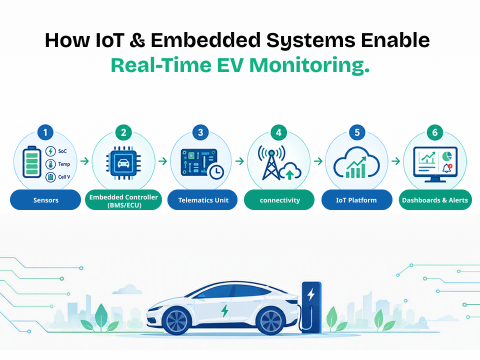
EV monitoring looks like a cloud product with sensors attached, but the chain runs the other way the embedded end carries most of the weight.
- Sensors on the pack, powertrain, and thermal system produce raw electrical signals.
- An embedded controller, the BMS and other ECUs- conditions those signals, runs control logic, and publishes structured values onto the vehicle bus, usually CAN.
- Firmware on a telematics unit reads the bus, filters and timestamps the data, and decides what to send now versus log and forward later.
- Connectivity, usually cellular with local buffering, carries data off the vehicle.
- A backend / IoT platform ingests the streams and computes trends such as SoH degradation or charging efficiency.
- Dashboards and alerts turn that into decisions.
If the embedded layer samples too slowly, mislabels a CAN signal, or lets clocks drift between modules, no cloud analytics can recover the lost fidelity. Real-time monitoring is decided at the device and only displayed in the cloud.
Key Use Cases for Connected EV Monitoring
A few use cases carry most of the value. Battery health monitoring tracks SoH and cell balance to flag packs ageing abnormally before they fail. EV fleet monitoring aggregates range, charge state, and location across every vehicle at once. Remote diagnostics lets an engineer read fault codes and sensor history without pulling the vehicle in. Charging monitoring covers session duration, energy delivered, and charge rate, feeding billing accuracy and uptime. Predictive maintenance builds on these; it's where machine-learning models earn their keep, spotting the drift that precedes a failure.
Why Real-Time EV Monitoring Matters for Fleets and OEMs
For fleets, the payoff is visibility and timing: knowing SoC and SoH across every vehicle turns charging, dispatch, and maintenance into evidence-based decisions, and faults surface as alerts rather than roadside failures. For OEMs, field data shows how vehicles and batteries behave across climates and duty cycles, which informs calibration and warranty models. For charging operators, live session data keeps chargers available and billing accurate. No specific savings are guaranteed, but better data supports better operational decisions.
Technical Challenges in Building EV Monitoring Systems
Most failure modes sit at the edges. Noise and calibration drift corrupt SoC, and SoH estimates downstream, so sensor data has to be disciplined at the source. Connectivity interruptions are a given, so firmware must buffer and reconcile rather than assume a live link. Embedded processing runs on hardware with a power budget to respect.
Security is first-class once a vehicle is addressable over a network, so device authentication, encrypted transport, and signed OTA updates belong in the design from the start. Mapping CAN signals to clean cloud data models across different vehicle architectures is where many projects lose time, and the stack has to stay maintainable for vehicles that stay in service for years.
Where Embedded Engineering Fits
EV monitoring is not primarily a dashboard problem; the dashboard is the last five percent. Everything a manager sees depends on embedded firmware that reads sensors correctly, control units that expose the right data, real-time processing within tight constraints, and security that holds up in the field.
That is the layer Evon Technologies works in - its embedded and mobility experience spans EV control units, battery-management logic, and charging-system firmware, alongside IoT application development and secure device-to-cloud integration.
Conclusion
Real-time electric vehicle monitoring works only when the embedded and IoT layers are designed as one system: sensors and firmware decide whether the data is trustworthy, connectivity whether it arrives in time, and the application layer whether anyone can act on it. If you are building a connected EV, a charging system, or a fleet-monitoring platform, the underlying embedded and IoT architecture is as important as the application layer.
Evon Technologies works across embedded firmware, EV control units, IoT connectivity, vehicle monitoring, and connected mobility solutions - engineered from the device up. Our extensive client list includes the Indian Defense Sector. Write to us at This email address is being protected from spambots. You need JavaScript enabled to view it. or get in touch here to discuss top embedded software solutions for you.